


SoftWave Therapy Blog: Pain Relief Tips from Winston-Salem
Upper Back and Shoulder Blade Pain: Finding Lasting Relief with SoftWave Therapy

That Nagging Ache Between Your Shoulder Blades: Upper Back Pain Relief in Winston-Salem
Upper back pain has a way of hanging around. It might feel like a burning knot just inside your shoulder blade, a deep ache that spreads across your upper back by the end of the day, or a sharp catch when you take a deep breath or turn to look over your shoulder. You rub it, stretch it, and press it against a door frame, and it eases for a moment before coming right back. For many people in Winston-Salem, this kind of pain lingers for months and starts to affect sleep, work, and everything in between.
At Stoetzel Chiropractic Clinic in Winston-Salem, NC, Dr. John Stoetzel helps patients find the true source of upper back and shoulder blade pain and address it with care that goes beyond temporary relief. Along with chiropractic care, the clinic offers SoftWave Tissue Regeneration Technology (TRT), a non-invasive, drug-free therapy designed to support the body's own healing in muscle and connective tissue that has been strained for a long time.
Understanding the Anatomy of the Upper Back
Your upper back, or thoracic spine, is made up of twelve vertebrae that connect to your ribs. This region is built for stability, protecting your heart and lungs, so it naturally moves less than your neck or lower back. Layered over it are several muscles that control your shoulder blades, which are also called scapulae:
- Rhomboids: These sit between your spine and the inner edge of each shoulder blade and pull the shoulder blades back and together.
- Middle and lower trapezius: These help stabilize and move the shoulder blades and support good posture.
- Levator scapulae: This muscle runs from the side of your neck to the top inner corner of the shoulder blade, a very common spot for tight, painful knots.
- Rib and spinal joints: Small joints where the ribs meet the spine can become stiff or irritated and cause sharp, localized pain.
What Causes Pain Between the Shoulder Blades?
Posture and Repetitive Strain
The most common cause is simple overload. Rounded shoulders and a forward head position, whether from desk work, driving, or looking down at a phone, keep the muscles between your shoulder blades stretched and working all day. Over time, these muscles become fatigued, tight, and tender, and painful knots can develop.
Lifting, Carrying, and Overuse
Parents carrying children, workers who lift or reach overhead, and people who spend weekends on yard work or home projects can strain the muscles and connective tissue of the upper back. Sports with repetitive arm motion, such as golf, tennis, and swimming, can also overload this area.
Joint Stiffness and Referred Pain From the Neck
When the joints of the thoracic spine or ribs stop moving well, the surrounding muscles often tighten to guard them. Problems in the neck can also send pain into the area between the shoulder blades, which is one reason the spot that hurts is not always the source of the problem.
When Upper Back Pain Needs Prompt Medical Attention
Most upper back pain comes from muscles and joints, but not all of it. Pain between the shoulder blades can sometimes be related to the heart, lungs, gallbladder, or other organs. If your pain comes with chest pressure, shortness of breath, sweating, nausea, fever, unexplained weight loss, or numbness or weakness in your arms or legs, or if it followed a fall or accident, seek medical care right away.
Why Conventional Approaches Often Fall Short
Typical approaches include rest, heat, stretching, massage, over-the-counter pain relievers, and physical therapy. Many of these help, and improving your posture and strengthening the muscles that support your shoulder blades is worth doing. Some people receive trigger point injections or muscle relaxants for stubborn knots.
The challenge is that long-standing upper back pain often involves tissue that has been strained and irritated for so long that it is stuck in a cycle of incomplete healing. Circulation in chronically tight muscle may be reduced, and medications and injections are designed to quiet symptoms rather than help the tissue rebuild. That is why the same knot keeps coming back, even after a great massage.
If pain between your shoulder blades has been wearing you down, you do not have to keep living with it. Book a SoftWave Therapy evaluation with Dr. John Stoetzel to learn whether it is a good fit for you.
How SoftWave Helps Upper Back and Shoulder Blade Pain
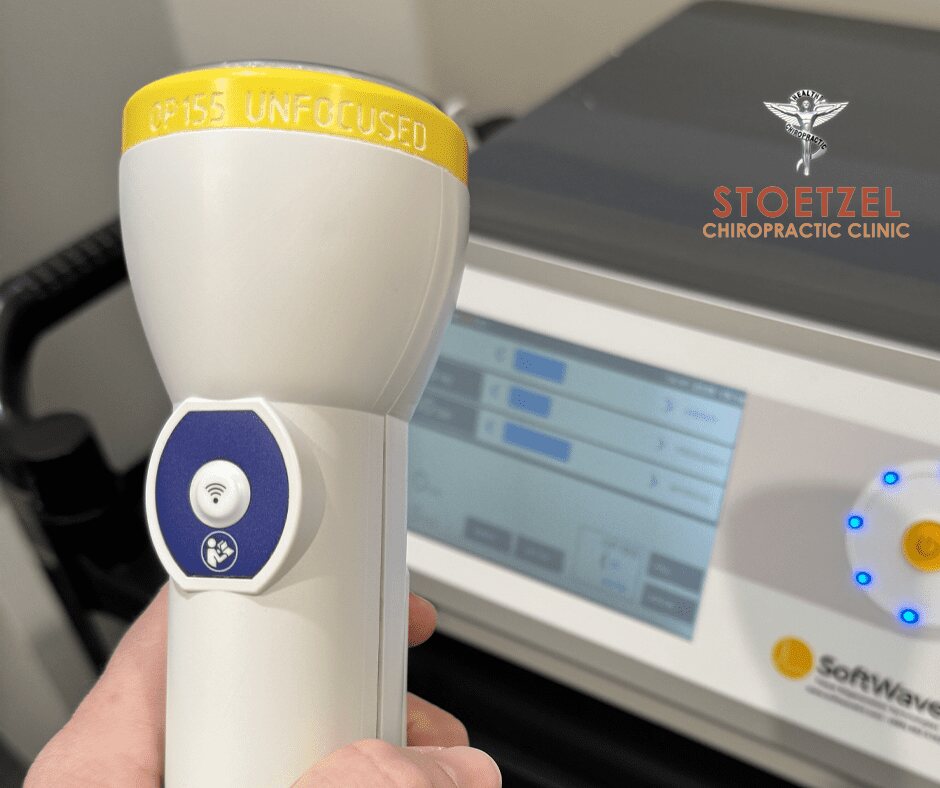
SoftWave TRT uses electrohydraulic, spark-generated broad-focused acoustic waves delivered through a patented parabolic reflector. It is the only broad-focused shockwave technology, allowing the energy to reach deep into a wide area of tissue. Upper back pain rarely sits in one tiny spot. It usually involves a band of muscle and connective tissue along and between the shoulder blades, which makes broad coverage especially useful.
The Science in Plain Language
- Improved circulation. SoftWave is designed to trigger angiogenesis, the growth of new blood vessels, through signaling molecules such as VEGF and eNOS, along with a temporary increase in blood flow.
- Repair cell activation. The waves are designed to activate your resident stem cells and encourage them to migrate to the treated area.
- Tissue rebuilding. Factors such as PCNA and BMP support cell growth and collagen production.
- Calmer inflammation and nerves. The therapy helps guide inflammation toward healthy healing and regulates toll-like receptors that can keep pain signals firing.
- Clearing worn cells. SoftWave may help the body clear senescent cells that keep chronic problem areas stuck.
Better Together: SoftWave and Chiropractic Care
Because upper back pain often involves both stiff joints and strained soft tissue, Dr. Stoetzel can combine SoftWave with chiropractic adjustments to restore movement in the thoracic spine and ribs. He can also suggest simple posture changes and exercises to strengthen the muscles that hold your shoulder blades in a healthy position, so the area is less likely to be overloaded again.
What to Expect
- Quick sessions: SoftWave sessions typically last about ten to fifteen minutes.
- No needles or downtime: The therapy is non-invasive, with no drugs or surgery, and you can return to your normal routine afterward.
- A series of visits: Most patients complete a series of sessions over roughly six to eight weeks.
- Continued healing: Because the therapy works by reactivating repair processes, healing often continues for weeks to months after the final session.
SoftWave is not a guaranteed cure and does not replace medical advice. Many patients report that their upper back feels looser and less painful as their sessions progress, but results vary from person to person. Dr. Stoetzel will start with a careful evaluation to find where your pain is coming from and whether SoftWave is likely to help.
Learn more: SoftWave Therapy for Neck Pain in Winston-Salem
Ready to Take the Next Step?
If the ache between your shoulder blades keeps coming back no matter how much you stretch or rub it, schedule a visit and find out whether SoftWave Therapy can help you finally get ahead of it.
Request your SoftWave Therapy new patient visit online today
Contact Stoetzel Chiropractic Clinic
Stoetzel Chiropractic Clinic
3333 Brookview Hills Blvd, Suite 101
Winston-Salem, NC 27103
Phone: (336) 773-1177
Our Main Office Website: https://winston-salemchiro.com
‹ Back
Recent Posts
-
What FDA Clearance Means for SoftWave Therapy
November 24, 2026
-
SoftWave Therapy Myths vs Facts: What Winston-Salem Patients Should Know
November 19, 2026
-
Why SoftWave Therapy and Chiropractic Care Work Better Together
November 14, 2026
-
-

 3333 Brookview Hills Blvd