
SoftWave Therapy Blog: Pain Relief Tips from Winston-Salem
Desk Workers in Winston-Salem: Easing Back and Neck Pain From Sitting All Day

Sore Back and Stiff Neck After Another Day at the Desk? Winston-Salem Office Workers, Read This
You sit down at your desk with good intentions. By lunch your shoulders have crept up toward your ears, and by the end of the day your lower back aches, your neck feels like a tight rope, and turning your head to back out of the parking lot takes more effort than it should. If that sounds like your workweek in Winston-Salem, whether you work in a downtown office or a spare bedroom turned home office, you are far from alone.
At Stoetzel Chiropractic Clinic in Winston-Salem, NC, Dr. John Stoetzel works with desk workers every week who are tired of living with that daily ache. Along with practical changes to how you sit and move, the clinic offers SoftWave Tissue Regeneration Technology (TRT), a non-invasive, drug-free therapy designed to support your body's own healing in tissue that has been strained for months or years. First, though, it helps to understand why a chair and a screen can cause so much trouble.
Why Sitting All Day Is So Hard on Your Back and Neck
Sitting is not harmful in small doses, but holding the same position for hours places steady, low-level stress on the same muscles, joints, and discs, and that stress adds up.
The Forward Head Posture Problem
When you lean toward a monitor or look down at a laptop or phone, your head drifts forward of your shoulders. The farther forward your head sits, the harder the upper trapezius and levator scapulae muscles must work to hold it up. Many people develop tender knots, tension headaches at the base of the skull, and tightness across the tops of the shoulders.
What Happens to the Lower Back
In the lower back, prolonged sitting tends to flatten the natural inward curve of the spine, especially when you slump. This position can increase pressure on the discs and strain the ligaments and small joints of the lumbar spine. At the same time, the hip flexor muscles at the front of your hips stay in a shortened position for hours, which can pull on the pelvis and lower back when you finally stand up. That is why so many desk workers feel stiff the moment they get out of their chair.
Reduced Circulation and Slow Recovery
Muscles held in one position receive less fresh blood flow than muscles that are moving, so they get less oxygen and fewer nutrients. Small strains pile up faster than your body can repair them, and a temporary ache slowly turns into a chronic one.
Common Desk-Related Pain Patterns
Certain patterns show up again and again:
- Neck stiffness and tension headaches from forward head posture and long hours looking at screens.
- Tight, knotted upper shoulders where the trapezius and levator scapulae muscles hold tension.
- Lower back pain and stiffness that is worst when you first stand up after sitting.
If you ever notice numbness, tingling, or weakness running down an arm or leg, loss of bladder or bowel control, or pain after a fall or accident, those are signs to get a prompt medical evaluation rather than assuming it is just posture.
What Usually Gets Recommended, and Where It Falls Short
The standard advice for desk-related pain is sensible, and much of it genuinely helps. A better chair, a monitor at eye level, and regular breaks to stand and walk can all reduce daily strain. Stretching, massage, chiropractic adjustments, and over-the-counter pain relievers can all ease stiffness and take the edge off a rough day.
Still, many people make these changes and keep hurting, often because the tissue has been strained so long that it is stuck in a cycle of irritation and incomplete healing. Ergonomics can stop new damage from piling up, and pain relievers can quiet the signal for a few hours, but neither one is designed to help long-stressed muscle and connective tissue actually repair. That is where SoftWave can fit in.
How SoftWave Helps Desk Workers Find Relief
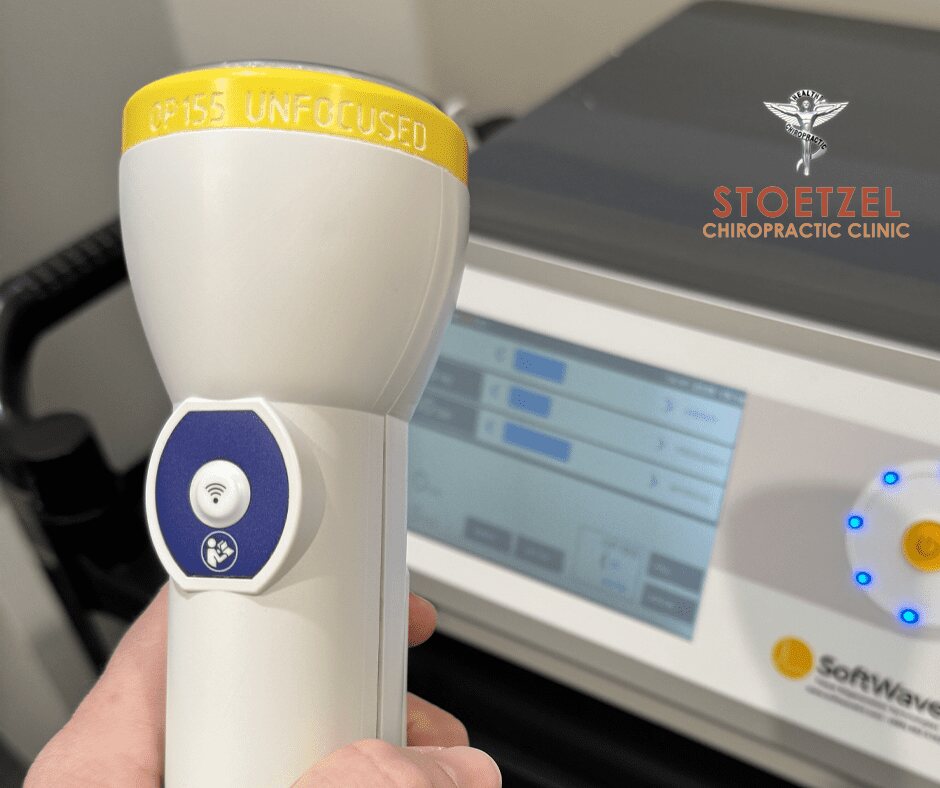
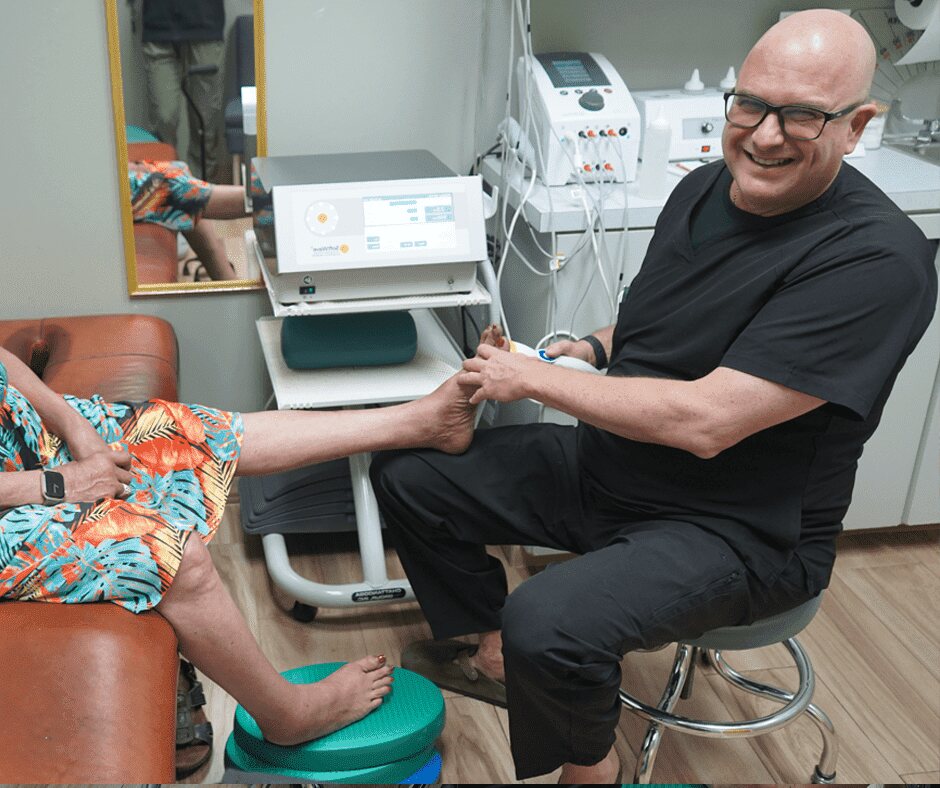
SoftWave TRT uses electrohydraulic, spark-generated broad-focused acoustic waves delivered through a patented parabolic reflector. It is the only broad-focused shockwave technology, which means the energy reaches deep into a wide treatment area rather than staying near the surface. That broad coverage lets Dr. Stoetzel treat the whole region where strain has built up in a tight neck or achy lower back.
If your workday leaves you rubbing your neck or bracing your lower back every time you stand up, you do not have to accept that as normal. Schedule a SoftWave Therapy visit with Dr. John Stoetzel and find out whether it is a good fit for you.
The Science in Plain Language
- Better blood flow. SoftWave is designed to trigger angiogenesis, the growth of new blood vessels, through signaling molecules such as VEGF and eNOS, along with a temporary increase in circulation to tissue that has been starved of it.
- Calmer inflammation. Rather than simply shutting inflammation off, the therapy helps guide it back toward a healthy healing pattern.
- Your own repair cells. The waves are designed to activate your body's resident stem cells and encourage them to move to the treated area.
- Rebuilding tissue. Factors such as PCNA and BMP support cell growth and collagen production, the building blocks of healthier connective tissue.
- Clearing out worn cells. SoftWave may help the body clear senescent cells, old and damaged cells that can keep an area stuck in a low-grade, unhealed state.
Why SoftWave Fits a Busy Work Schedule
Desk workers often put off care because they cannot afford to lose time. SoftWave sessions typically last only about ten to fifteen minutes, so many patients can fit a visit in before work, during a lunch break, or on the way home. There are no needles, no medications, no surgery, and no downtime. Most patients complete a series of sessions over roughly six to eight weeks, and because the therapy works by reactivating your body's repair processes, healing often continues for weeks to months after the last session.
SoftWave also pairs naturally with the other things that help desk workers. At Stoetzel Chiropractic Clinic, it can be combined with chiropractic care to improve how your spine moves, along with simple guidance on workstation setup and movement habits. The goal is to help the tissue recover and reduce the daily strain that caused it.
Simple Habits That Support Your Recovery
- Move often. Stand up, walk, or change position every thirty to sixty minutes.
- Raise your screen. Keep the top of your monitor near eye level so your head stays over your shoulders.
- Get outside. A short walk on a local greenway at lunch is good for both your back and your mind.
Realistic Expectations
SoftWave is not a cure-all and it does not replace advice from your physician. Every person responds differently, and long-standing pain usually improves gradually rather than overnight. Many patients report feeling looser and less sore as their series of sessions progresses, but results vary. Dr. Stoetzel will start with an honest evaluation of where your pain is coming from and whether SoftWave is likely to help your specific situation.
Learn more: SoftWave Therapy for Back Pain in Winston-Salem
Ready to Take the Next Step?
If long hours at a desk have left you with a back or neck that never fully recovers, a short evaluation at Stoetzel Chiropractic Clinic can help you understand what is going on and whether SoftWave Therapy can help you feel better at work and at home.
Request your SoftWave Therapy new patient visit online today
Contact Stoetzel Chiropractic Clinic
Stoetzel Chiropractic Clinic
3333 Brookview Hills Blvd, Suite 101
Winston-Salem, NC 27103
Phone: (336) 773-1177
Our Main Office Website: https://winston-salemchiro.com
‹ Back
Recent Posts
-
What FDA Clearance Means for SoftWave Therapy
November 24, 2026
-
SoftWave Therapy Myths vs Facts: What Winston-Salem Patients Should Know
November 19, 2026
-
Why SoftWave Therapy and Chiropractic Care Work Better Together
November 14, 2026
-

-

 3333 Brookview Hills Blvd