


SoftWave Therapy Blog: Pain Relief Tips from Winston-Salem
Ankle Sprains That Never Fully Healed: Treating Chronic Ankle Pain with SoftWave Therapy

That Old Ankle Sprain Still Bothering You? Chronic Ankle Pain Relief in Winston-Salem
Almost everyone has rolled an ankle at some point. You stepped off a curb wrong, landed on someone's foot during a basketball game, or caught a root on a trail at Salem Lake. Most of the time, the swelling goes down, the bruising fades, and life moves on. But for some people, the ankle never quite feels right again. It aches after a long day, swells after activity, feels stiff in the morning, or gives way on uneven ground. At Stoetzel Chiropractic Clinic, Dr. John Stoetzel helps Winston-Salem patients who are tired of living with an ankle that stays sore months or even years after the original injury. One of the options he offers is SoftWave Tissue Regeneration Technology (TRT), a non-invasive therapy designed to help restart healing in tissue that never fully recovered.
What Happens When You Sprain an Ankle
An ankle sprain is an injury to the ligaments, the tough bands of connective tissue that hold the bones of the ankle together. The most common type happens when the foot rolls inward, stretching or tearing the ligaments on the outside of the ankle. Sprains are usually graded by severity, from a mild stretch to a partial tear to a complete tear.
Ligaments are strong, but they have a relatively limited blood supply, so they heal more slowly than muscle. When they do heal, they often repair with scar tissue that is not as organized or as springy as the original ligament. If the ankle is not rehabilitated well, that healing can be incomplete.
Why Some Sprains Never Fully Heal
Ankle sprains are often brushed off as minor injuries, and that is part of the problem. A few common reasons an ankle stays painful include:
- Skipping rehab. Many people rest until it stops hurting, then go straight back to normal life without rebuilding strength and balance.
- Lost balance and position sense. Ligaments contain nerve endings that help your brain know where your foot is. After a sprain, that sense can be dulled, making another roll more likely.
- Repeat sprains. Each new sprain can further stretch the ligaments, leading to an ankle that feels loose or unstable.
- Lingering irritation. Scar tissue, thickened joint lining, or irritated tendons around the ankle can keep pain going long after the original injury.
- Hidden injuries. A sprain can also injure cartilage in the ankle joint or the tendons on the outside of the ankle, which may be missed at first.
Signs Your Ankle Is Still Not Right
- Aching or swelling after walking, standing, or sports
- Stiffness, especially first thing in the morning
- A feeling that the ankle might give way on uneven ground or stairs
- Tenderness on the outside of the ankle that never quite goes away
Conventional Options and Their Limits
Rehabilitation is the backbone of recovering from an ankle sprain. Balance training, strengthening of the muscles around the ankle and hip, and gradual return to activity help restore stability. Other common approaches include ankle braces or taping for support, anti-inflammatory medication for flare-ups, and in some cases corticosteroid injections for persistent joint pain.
These approaches have real value, but they have limits. Braces support the ankle without repairing it. Medication and injections can quiet symptoms for a while without improving the tissue itself. For ankles with significant ligament damage and ongoing instability despite good rehab, surgical repair or reconstruction may be recommended, which involves a lengthy recovery. Many people with chronic ankle pain fall somewhere in between: their ankle is not unstable enough for surgery, but it is not healthy enough to stop hurting.
How SoftWave Helps Chronic Ankle Pain
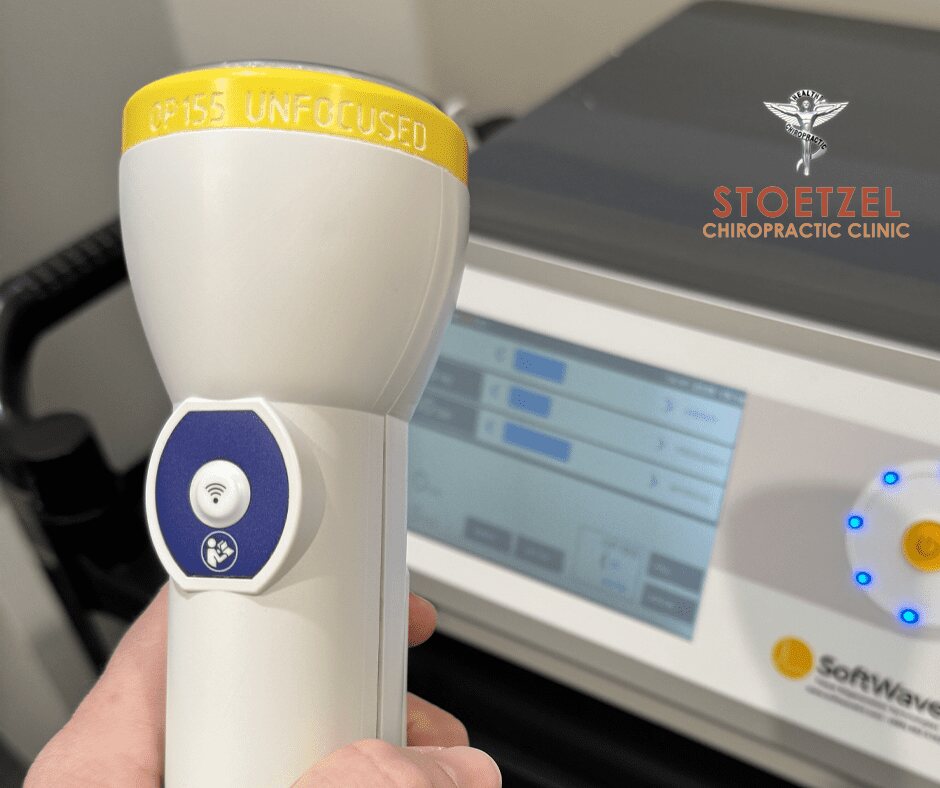
SoftWave TRT uses electrohydraulic, spark-generated acoustic waves directed through a patented parabolic reflector. This produces a broad-focused field of energy, and SoftWave is the only broad-focused shockwave technology, as opposed to radial, electromagnetic, or piezoelectric devices. Because the ankle contains many ligaments and tendons packed close together, the broad treatment field allows Dr. Stoetzel to address the whole region rather than a single point. The waves act as a trigger that prompts the body to restart its own healing process in tissue that has stalled.
The Science in Plain Language
- Stem cell activation. SoftWave is designed to activate resident stem cells and encourage them to migrate to the injured ligaments and tendons.
- New blood vessel growth. Through VEGF and eNOS signaling, it supports angiogenesis, which is important for ligaments with limited circulation.
- Collagen and tissue repair. PCNA and BMP signaling support cell proliferation and collagen production, the building blocks of ligaments and tendons.
- Healthier inflammation. The therapy helps modulate inflammation so a stuck injury can move toward resolution.
- Clearing old cells. It may help clear senescent cells that keep chronic tissue stuck, and it regulates toll-like receptors involved in pain and immune signaling.
If an old ankle injury is still slowing you down, you do not have to accept it as permanent. Schedule a SoftWave ankle evaluation with Dr. Stoetzel in Winston-Salem.
What to Expect From Treatment
Your visit begins with a thorough exam of your ankle, foot, knee, and hip, along with a review of your history of sprains. Dr. Stoetzel will check stability, motion, and tenderness, and if there are signs of a fracture, a cartilage injury, or a ligament tear that needs surgical attention, he will point you toward the right imaging or specialist.
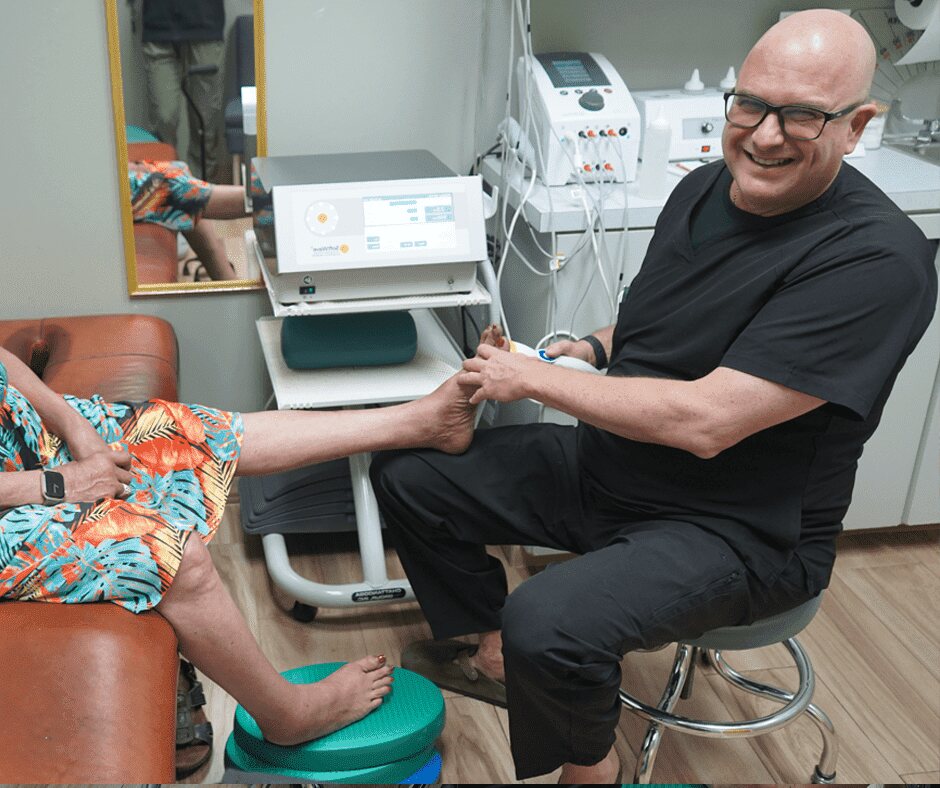
If SoftWave is a good fit, sessions typically last about ten to fifteen minutes. There are no needles, no medication, and no downtime. Most patients complete a series of sessions over roughly six to eight weeks, and because SoftWave works by stimulating your own repair biology, healing often continues for weeks to months after the final session.
Rebuilding a Stronger Ankle
SoftWave works best alongside a plan to restore strength and control. That may include:
- Balance and single-leg exercises to retrain position sense
- Strengthening for the calf, the muscles on the outside of the lower leg, and the hips
- Chiropractic care to improve motion in the ankle, foot, and the joints above them
- Smart footwear choices and, when appropriate, temporary bracing during sports
Setting Realistic Expectations
SoftWave is not a guarantee and does not replace medical care. A ligament that has been fully torn will not be reattached by SoftWave, and a truly unstable ankle may still need surgical evaluation. What SoftWave offers is a way to support healing in irritated, slow-to-recover tissue so that rehab can do its job. Many patients report less aching and more confidence on their feet as treatment progresses. SoftWave technology has been studied at leading institutions and is used by clinicians who work with professional and collegiate athletes.
Learn more: SoftWave Therapy for Plantar Fasciitis and Foot Pain in Winston-Salem
Ready to Take the Next Step?
If your ankle has never felt the same since that sprain, reach out and let Dr. Stoetzel help you find out why and build a plan to get you moving with confidence again.
Request your SoftWave Therapy new patient visit online today
Contact Stoetzel Chiropractic Clinic
Stoetzel Chiropractic Clinic
3333 Brookview Hills Blvd, Suite 101
Winston-Salem, NC 27103
Phone: (336) 773-1177
Our Main Office Website: https://winston-salemchiro.com
‹ Back
Recent Posts
-
What FDA Clearance Means for SoftWave Therapy
November 24, 2026
-
SoftWave Therapy Myths vs Facts: What Winston-Salem Patients Should Know
November 19, 2026
-
Why SoftWave Therapy and Chiropractic Care Work Better Together
November 14, 2026
-

-

 3333 Brookview Hills Blvd